
MyAryaka Self-Onboarding
Transforming Customer Self-Onboarding Experience Through Comprehensive UX Research
A deep-dive research initiative to simplify network provisioning, reduce team dependency, and empower customers with seamless self-service capabilities.
Executive Summary
Aryaka's MyAryaka Config Portal enables customers to manage site setups and network services. However, the current system suffers from a poorly structured design that complicates onboarding tasks, forcing the provisioning team to handle setup and configuration for customers rather than enabling self-service.
Key Challenges Identified
- Over-reliance on the Provisioning Team for customer onboarding
- Inconsistent plan controls allowing customers to exceed subscription limits
- Difficult Point of Presence (POP) selection based on location and performance
- Lack of consolidated overview for Smart Services configuration
- Redundant fields slowing down the onboarding process
Background & Problem Statement
The MyAryaka Config Portal was designed to enable customers to independently manage their network configurations. However, the current implementation has created significant friction in the onboarding process, resulting in heavy reliance on the provisioning team and extended setup times.
Research Methodology
Heuristic Evaluation
Expert review of the current portal against established usability principles
User Interviews
In-depth conversations with customers and internal team members
Usability Testing
Task-based testing to identify friction points in real workflows
User Personas
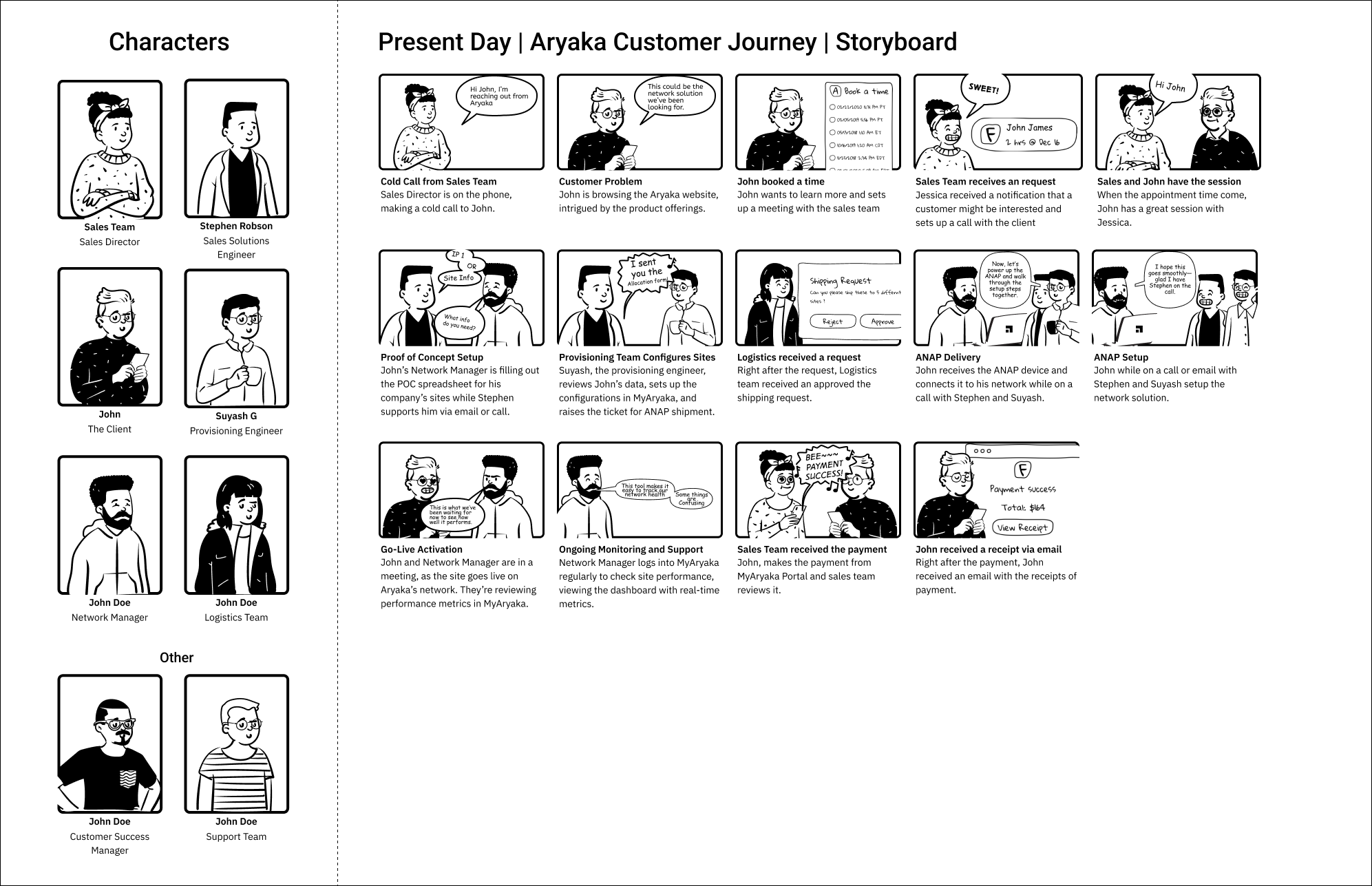
Through our research, we identified three primary personas representing different stakeholders in the onboarding process.
Stephen Robson
Sales Solutions Engineer
Background
Technical sales professional who attends discovery meetings, analyzes customer needs, and coordinates with provisioning teams for POC setups.
Goals
- • Quickly set up POCs for potential customers
- • Showcase Aryaka's value proposition
- • Minimize technical friction during sales
Pain Points
- • Dependency on provisioning team availability
- • Lack of visibility into setup progress
- • Complex technical requirements
Suyash G. Patil
Provisioning Engineer
Background
Technical expert responsible for configuring network services, managing POC setups, and ensuring smooth customer onboarding.
Goals
- • Efficiently handle multiple customer setups
- • Reduce repetitive configuration tasks
- • Focus on complex technical issues
Pain Points
- • Overwhelmed with basic setup requests
- • Manual data entry and configuration
- • Lack of standardized processes
R Rajath
Customer - Network Manager
Background
IT professional managing enterprise network infrastructure, responsible for deploying and maintaining Aryaka services across multiple locations.
Goals
- • Quickly deploy network services
- • Maintain control over configurations
- • Minimize downtime and issues
Pain Points
- • Unclear configuration requirements
- • Waiting for provisioning team support
- • Difficulty tracking setup progress
Customer Journey Mapping
We mapped the complete customer journey across 5 phases, identifying touchpoints, pain points, and opportunities for improvement.
Pre-Sales & Qualification
POC Configuration
Internal Kickoff & Execution
Post-POC & Go-Live
Support & Monitoring
Key Findings & Pain Points
Through our research, we identified critical pain points across all 5 phases of the customer journey.
Phase 1: Pre-Sales & Customer Qualification
Pain Points
- • Understanding technical pain points of customer network setup
- • Comparing complex technical specifications across competitors
- • Potential difficulty in setting expectations for self-onboarding
Phase 2: POC Configuration
Pain Points
- • Events are often incomplete, requiring follow-up to collect missing data
- • Coordination between sales and provisioning teams can be inefficient
- • Manual entry of data leads to potential errors
Phase 3: Internal Kickoff & POC Execution
Pain Points
- • The need for frequent back-and-forth to clarify missing or incorrect data
- • Unclear shipping timelines lead to inefficient planning
- • Lack of visibility into real-time shipment tracking
- • Technical issues like incorrect IP addresses or routing settings
Phase 4: Post-POC & Go-Live
Pain Points
- • Miscommunication between users and provisioning teams
- • Technical issues like incorrect IP addresses or routing settings
- • Coordination delays between Support and Logistics
Phase 5: Handoff to Support & Ongoing Monitoring
Pain Points
- • Some configuration settings may struggle with understanding team changes
- • Coordination time with provisioning team regarding support tickets
Recommendations & Solutions
Based on our findings, we developed comprehensive recommendations organized by implementation priority and expected impact.
Immediate Impact
Simplify Discovery & Showcase
Create streamlined packages with fixed pricing and speed/decision-making. Highlight key differentiators clearly.
Streamlined POC Configuration
Introduce templated packages with fixed pricing to speed up decision-making and reduce manual errors.
Enhanced MyAryaka Portal
Improve self-service configuration with better guidance, validation, and real-time feedback.
Automated Workflows
Reduce manual handoffs between teams with automated ticket creation and status updates.
Expected Impact
Implementation of these recommendations is projected to deliver significant improvements across key metrics.